
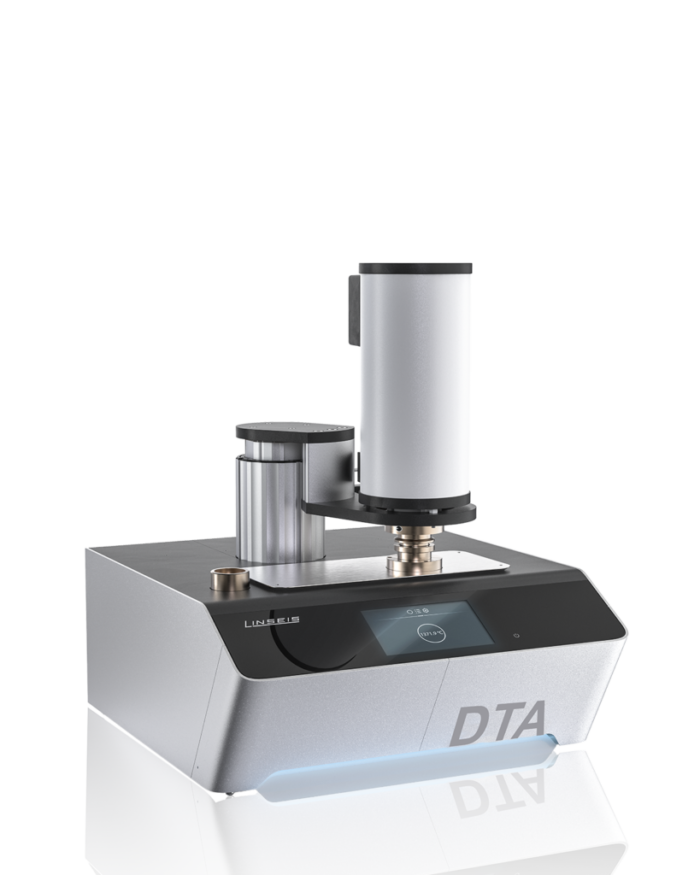
Description
Due to the large amount of information provided, differential thermal analysis is the most widely used thermal analysis method.
The Linseis high-temperature DTA L61 enables the highest calorimetric sensitivity, a short time constant and a condensation-free sample chamber in a single device.
Our concept guarantees an extremely high resolution with simultaneous baseline stability over the entire service life of the instrument.
We can therefore proudly claim that our DTA has become an indispensable tool for materials research and quality control.
The modular differential thermal analysis concept of the LINSEIS DTA L61 allows it to be equipped with various furnace types for an extremely wide temperature range from -150°C to 2400°C.
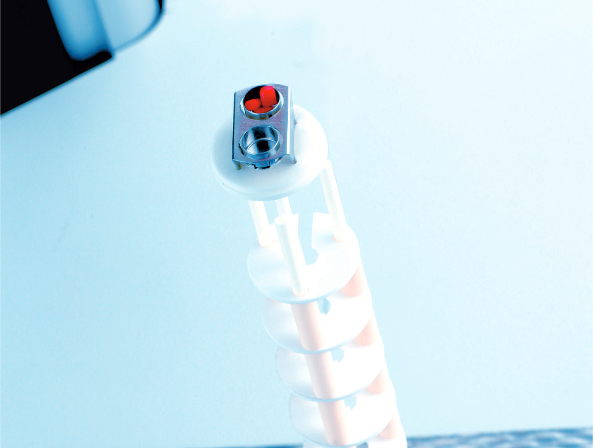
Various measuring sensors are available for the DTA as well as different crucible types.
The system can be coupled with a mass spectrometer or FTIR at any time to obtain further information.
Unique features
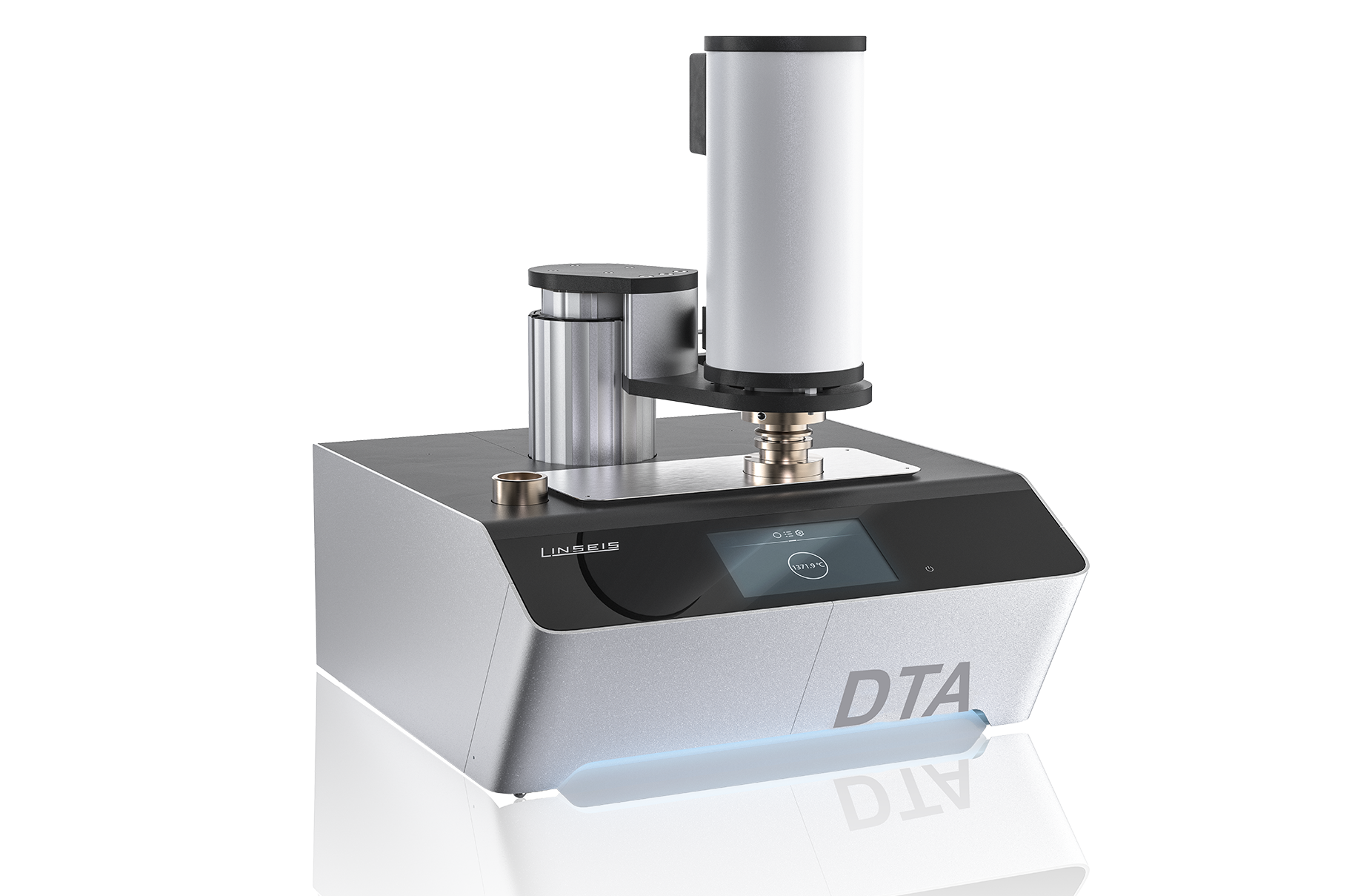 Extremely wide temperature range: measurements from -150°C to 2400°CHigh resolution and baseline stability: Stable and precise measurement results over the entire service life of the deviceModular design: different oven types and sensor types availableVacuum-tight system: carrying out measurements in high-purity gas atmospheres and under vacuum up to 10E-5 mbar
Specifications
| MODEL | HDSC L62* |
|---|---|
| Temperature range: | -150°C bis 500/1000°C, RT – 1400/1500/1600/1750/2000/2400°C |
| Sensor: | E/K/S/B/C |
| Sensor types: | DTA |
| Heating rate: | 0.001 K/min … 50 K/min |
| Cooling rate: | 0.001 K/min … 50 K/min |
| Sensor: | heat flux |
| Temperature modulation: | Yes |
| Atmosphere: | reduced, oxidizing, inert (static, dynamic) |
| Vacuum: | 10E-5 mbar |
| PC Interface: | USB |
| *Specifications depend on the configurations | |
Available accessories
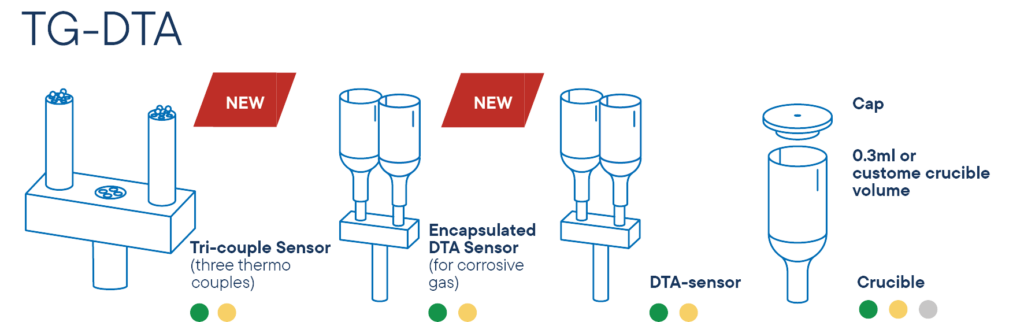
Various gas boxes: manual, semi-automatic and MFC controlled Variety of crucibles (gold, silver, platinum, aluminum, Al2O3, graphite, tungsten, stainless steel (high pressure), etc.) Various rotary and turbomolecular pumps Various measuring systems Optional gas analysis Software for calculating the DTA signal
Software
Making values visible and comparable
The powerful LINSEIS thermal analysis software, which is based on Microsoft® Windows®, performs the most important function in the preparation, execution and evaluation of thermoanalytical experiments, in addition to the hardware used.
With this software package, Linseis offers a comprehensive solution for programming all device-specific settings and control functions, as well as for data storage and evaluation.
The package was developed by our in-house software specialists and application experts and has been tried and tested over many years.

General functions
- Real-time color display
- Automatic and manual scaling
- Display of the axes freely selectable (e.g. temperature
e.g. temperature (x-axis) against delta L (y-axis)) - Mathematical calculations (e.g. first and second derivatives)
- Saving complete evaluations
- Multitasking function
- Multi-user function
- Zoom function for curve sections
- Any number of curves can be loaded on top of each other for comparison
- Online Help Menu
- Free labeling
- EXCEL® and ASCII export of measurement data
- Data smoothing
- Zero curves are offset
- Cursor function
- Statistical curve evaluation (mean value curve with confidence interval)
- Tabular printout of the data and expansion coefficients
- Calculation of Alpha Phys, Alpha Tech, relative expansion L/L0
- Curve arithmetic, addition, subtraction, multiplication
Applications
The Linseis DTA L61 uses a dynamic measuring principle.
It measures endothermic and exothermic heat flows between the sample and reference, which are caused by physical or chemical changes.
A DTA measurement is very often used to determine the purity of metal mixtures.
This is due to the fact that the melting point changes depending on the different amounts of impurities.
- Purity measurements
- Melting point determination (onset / offset)
- Stability of explosives (storage)