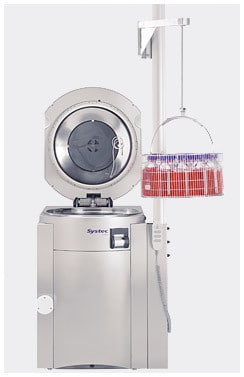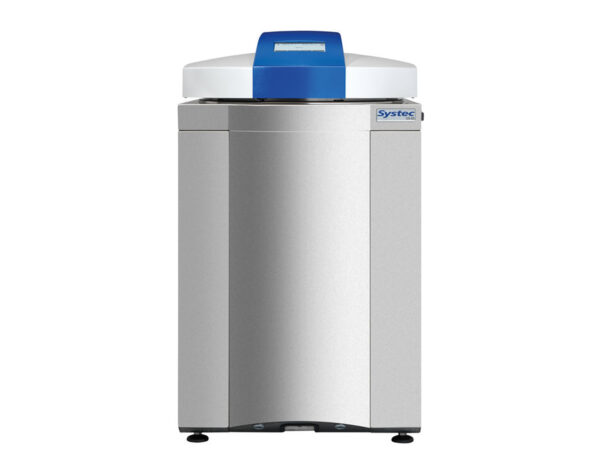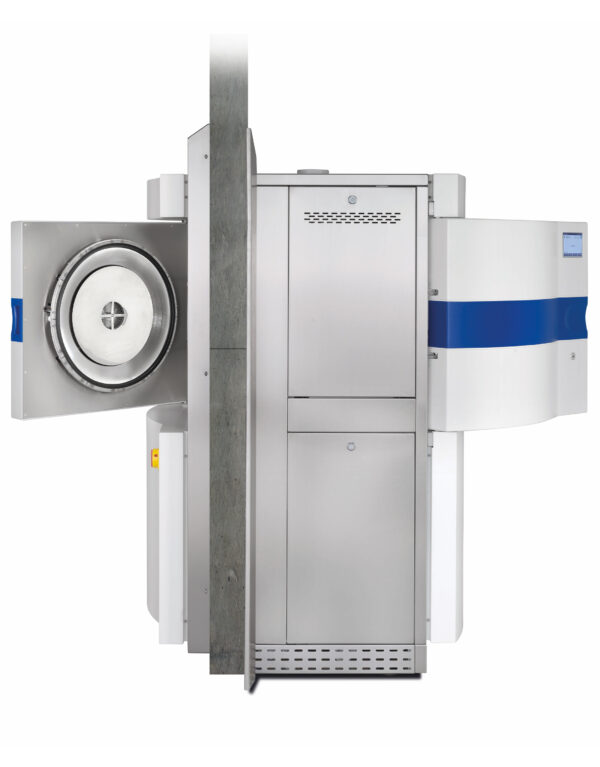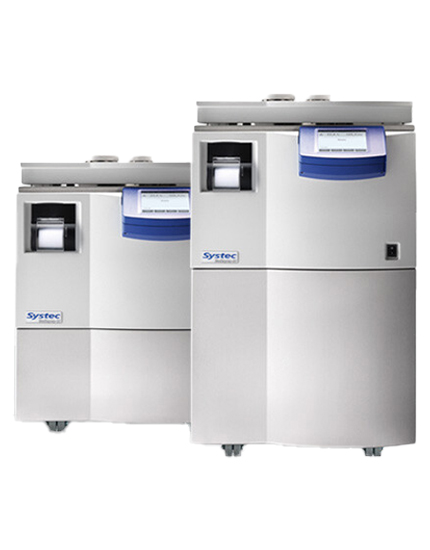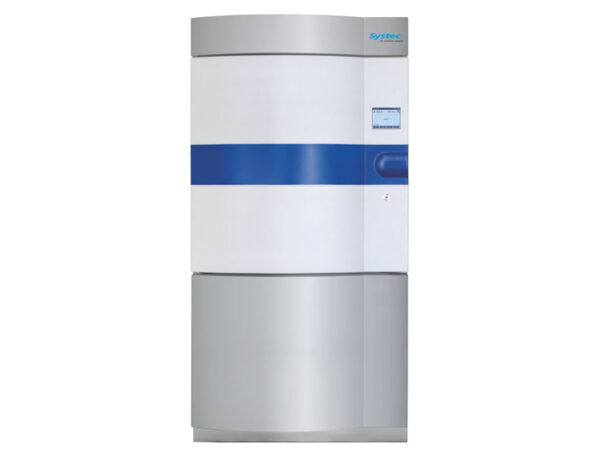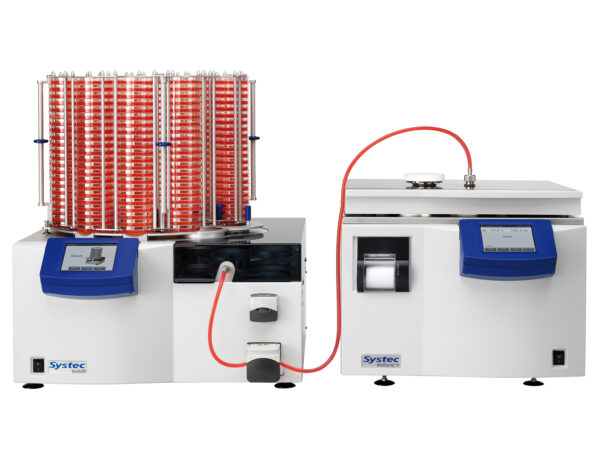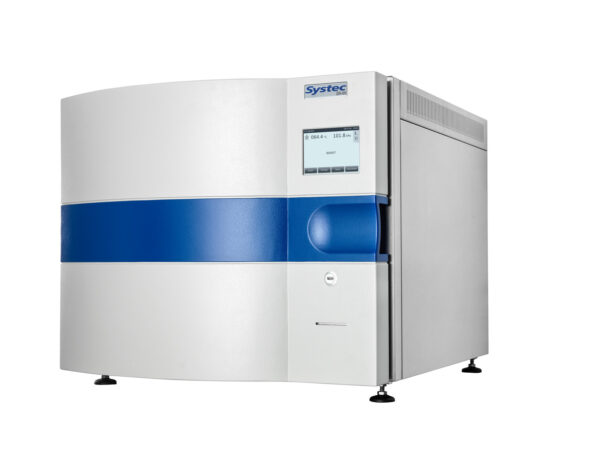
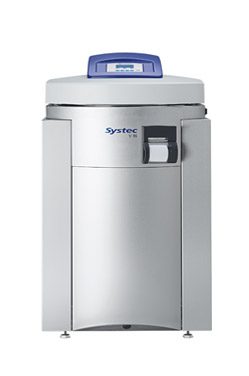
Vertical floor-standing autoclaves Systec VE-Series
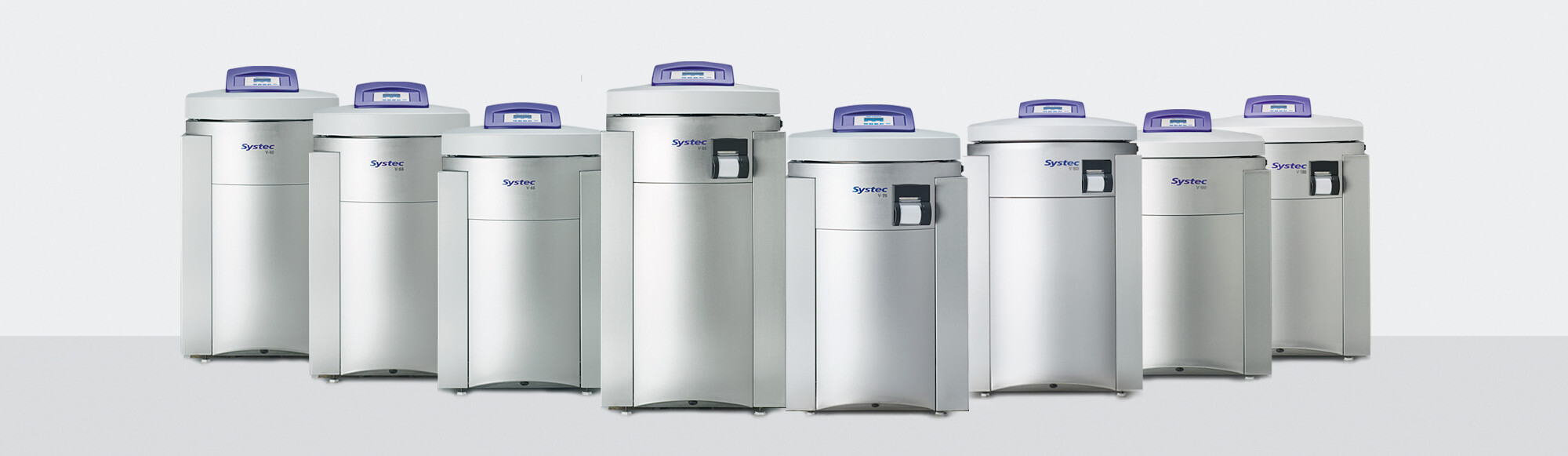
The Systec VE-Series, with its top-loading vertical autoclaves in 8 sizes with 40 to 150 liters of usable space, is characterized by its small footprint and large usable space height. The advantage: Optimal loading capacity for most standard medium bottles and Erlenmeyer flasks.
Two model ranges with different performance
| Type | Chamber dimensions Ø x depth (mm) | Chamber volume in liters total / nominal | Techn. Drawinf |
|---|---|---|---|
| Systec VE-40 | 344 x 450 | 45 / 40 | Download |
| Systec VE-55 | 344 x 600 | 60 / 55 | Download |
| Systec VE-65 | 400 x 500 | 73 / 65 | Download |
| Systec VE-75 | 400 x 600 | 85 / 75 | Download |
| Systec VE-95 | 400 x 750 | 104 / 95 | Download |
| Systec VE-100 | 500 x 500 | 117 / 100 | Download |
| Systec VE-120 | 500 x 600 | 137 / 120 | Download |
| Systec VE-150 | 500 x 750 | 166 / 150 | Download |
Systec VE-65 to Systec VE-150: Voltage 380-400V, 50/60 Hz, 16A
Other power supplies available on request.
Country-specific deviations possible.
| Standard Features | Systec ve |
|---|---|
| Internal heating elements within the autoclave chamber | ● |
| Housing, support frame and pressure vessel made of corrosion-resistant stainless steel | ● |
| Temperature and pressure range 140 °C, 4 bar absolute pressure | ● |
| LCD display and fully automatic microprocessor control | ● |
| Number of sterilization programs | 12 (optional: 25) |
| Code-secured access rights for changing parameters and further safety-relevant intervention | ● |
| Internal memory for storing up to 500 sterilization cycles | ● |
| Timer for starting programs | ● |
| Autofill: automatic demineralized water feed for steam generation | ● |
| Flexible PT-100 temperature sensor | ● |
| Temperature holding function for liquids after program finish | ● |
| Special program for Durham tubes | ● |
| Calculation of F0 value | ● |
| Special program for waste sterilization with pulsed heat-up for more efficient air exhaust | ● |
| Water-cooled steam exhaust, thermostatically controlled | ● |
| Programmable automatic door-opening on completion of program | ● |
| RS-232 interface for external data transmission (network-compatible) | ● |
| Available options | |
|---|---|
| Extension of temperature and pressure ranges to 150 °C / 5 bar absolute pressure (from chamber volumes of 65 liters and above) | ◌ |
| Options for process optimization | |
|---|---|
| Rapid cooling for efficient and safe cooling of liquids | ◌ |
| Exhaust filtration (including condensate inactivation) for safe sterilization of hazardous biological substances | ◌ |
| Options for documentation | |
|---|---|
| Integrated printer for batch documentation | ◌ |
| Systec ADS documentation software package f. comprehensive documentation | ◌ |
| Documentation SD: data storage on SD card for up to 10,000 sterilization cycles and transmission of data to a PC | ◌ |
Systec autoclaves are factory-prepared so that all options can be retrofitted at any time.
Further options and special programs as well as system accessories such as baskets, inserts, transport and loading systems are available on request.
Technology
High-tech engineering & all-around quality
Our autoclaves include pressure vessels made of stainless steel 316L (1.4404), with the housing and support frameworks made of steel as well. This makes the entire autoclave highly resistant to corrosion and very easy to clean. The housing and support framework are further enhanced with highly efficient top-quality Hanno-Tect for insulation. This material does not release any particles, allowing Systec autoclaves to satisfy the requirements of working under clean-room conditions.
Dual sensors standard in all autoclaves
Systec autoclaves use a temperature sensor in addition to an electronic pressure sensor to monitor both the pressure and temperature during the entire sterilization process. The flexible temperature sensor can be used within the chamber or alternatively in a reference vessel containing liquids.
Systec autoclaves are fitted with the following connections at the rear:
| Demineralized water inlet for steam generation | ● |
| Compressed air | ◌ |
| Cooling water | ● |
| Commin outlet | ● |
| RS-232 interface | ● |
| Flexiblle power cord with CEE-plug | ● |
Meeting all regulations and sterilization standards
Systec autoclaves are fit to withstand sterilization temperatures of up to 140 °C as well as steam pressures up to 4 bar absolute pressure.
Systec V-Series autoclaves can be augmented for higher pressure and temperature ranges, allowing temperatures of up to 150 °C and pressure levels of 5 bar (absolute pressure). In addition to adapting the chamber, the optional accessories for extending pressure and temperature ranges also adapt all safety elements and control components to the higher range of temperatures and pressure levels. This option can even be retrofitted on Systec Autoclaves.
Exception: Extension of temperature and pressure to 150 °C / 5 bar absolute pressure is not available for Systec V-40 or V-55 systems.
Conventional steam generation
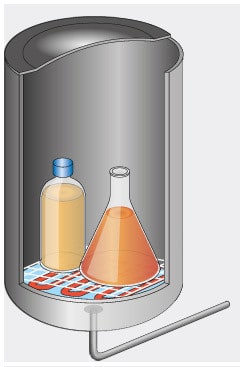
This system of generating steam includes heating elements which are integrated into the lower part of the chamber. Water can be fed into the system manually. Autoclave models Systec VE-Series can optionally be automatically fed with demineralized water with the DI-Water connection.
Condensing steam instead of removal
A PT-100-regulated cooling system is used to condense exhaust steam automatically. This prevents odors from developing and is especially useful for protecting plastic waste water pipes, if used.
Operation via Display
Systec VE-Series autoclaves are controlled via a large, easy-to-read display and a membrane keypad with acoustic input confirmation. The layout of all input elements is logical and ergonomic and thus allows for convenient operation of the autoclave. Menus are available in English, Spanish, French, German and Italian – other languages can be included on demand.
A specially developed microprocessor is responsible for carrying out all control functions. The processor controls not only the sterilization schedule but also steam pressure and temperature within the chamber. In addition, it manages all optional functions such as drying, rapid cooling as well as pre- and post-vacuum modes.
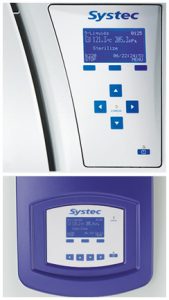
Programs:
1– 3 Solids
4 – 5 Waste bags
6 Liquid waste with regulated steam exhaust for cooling
7 Liquid waste with self-cooling
8 –10 Liquids with regulated steam exhaust for cooling
11 Liquids with self-cooling
12 Cleaning
All programs can be individually parametered.
Automatic door-opening functionality
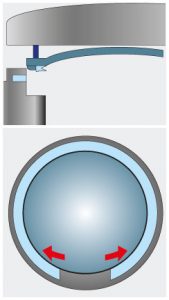
Systec autoclave chamber doors are locked automatically, utilizing a circumferential ring system* which engages when the door is being closed. The chamber is sealed using a special seal made of highly heat-resistant silicone; the seal tightens as more pressure is built inside the chamber. This occurs automatically, without requiring additional compressed air.
In full accordance with modern regulations for pressure vessels such as DIN EN (IEC) 61010-2-040, the door-locking mechanism is controlled by the interior temperature. Thus, the door remains firmly locked and sealed until all excess pressure within the chamber has dissipated. The door as well as various other elements of the housing and vessel are built using stainless steel and clad in an aesthetically pleasing front cover is made of insulated plastic that is highly resistant to heat. The same material is used for the control panel, display as well as parts of the control processing system. This prevents operators from coming into contact with heated surfaces.
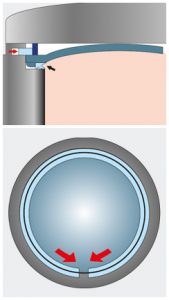
Automatic door opening
he door opens automatically either at the touch of a button or, optionally, automatically at the end of the sterilization program. This makes the process easy to operate and extremely practical for all workflows—especially when materials need to dry or cool down on their own after sterilization. Residual steam can thus escape without interrupting work or requiring further action. If the sterilized items remain in the autoclave for a short time, the residual heat is effectively used to dry them. To prevent contamination from outside during this automatic opening, the angle of the automatic door opening is limited to approx. 15°. The door can then be opened completely by hand to remove the sterilized items.
* Exceptions: On the Systec VE-40 and Systec VE-55 models, the lid is closed using a bolt mechanism rather than a ring system.
Systec autoclaves comply with the following standards and regulations:
Pressure vessel:
- 2014 / 68 / EU Pressure Equipment Directive
- ASME Boiler & Pressure Vessel Code, Section VIII, Division 1
- China Stamp
Other guidelines:
- 2014 / 35 / EU Low Voltage Directive
- 2014 /30 / EU on Electromagnetic Compatibility
All autoclaves are CE marked.
We will be happy to provide a complete list of standards and summary of regulations on request.
Application
Selecting the correct process for each sterilization run
There is a variety of sterilization options available that may be required to obtain reliable and validatable sterilization results, as well as rapid cooling times, especially when it comes to sterilizing liquids. Which options are available depends on the items that are to be sterilized. A validatable, biologically efficient sterilization process can only be ensured if the autoclave is configured correctly.
The table shown below can help with configuring your autoclave – however, we recommend consulting with our experts before configuring sterilization programs.
| Ventilation | Cooling | Drying | Other | ||||||
| Gravitation | Simple pre-vacuum | Pulsed excee pressure | Fractionated pre-vacuum | Conventional cooling with slow pressure release | Rapid cooling system with support pressure | Surface drying without vacuum | Drying with subsequent vacuum + Superdry | Exhaust air filtration | |
| Liquids | + | ? | – | – | ? | + | ? | – | |
| Unpacked non hollow items | + | + | + | + | ? | + | |||
| Porous materials (Filters, fabrics) | – | ? | ? | + | – | + | |||
| Hollow items (pipette tips, empty glassware, tubes and hoses) | – | – | – | + | – | + | |||
| Contaminated waste in destruction bags | – | – | ? | + | – | – | + | ||
+ Recommended procedure ? Possibly acceptable – Not possible
Heating up
The entire autoclave procedure typically includes only a small fraction of time dedicated to actual sterilization – for example, when sterilizing at 121 °C, only about 15 minutes are typically spent on sterilizing. While sterilizing liquids, in particular, phases of heating up the chamber and cooling it down again make up a considerably longer part of the sterilization procedure.
Conventional sterilization procedures
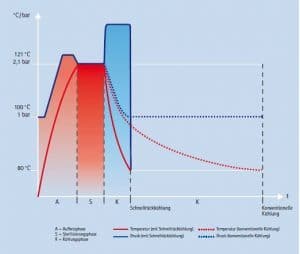
Most conventional autoclaves fail to properly sterilize liquids, as these typically reach only about 60 to 90 °C despite the chamber itself having already reached sterilization temperatures. This is because the temperature for sterilization within the chamber is reached quickly, while liquids need additional time for their temperature to equalize.
Up to 50 % shorter heat-up times as standard
Thanks to the regulation of pressure as well as temperature at the same time, the pressure within the vessel is evenly increased during the initial heat-up phase. As a result, temperature equalization between liquids and the chamber itself is sped up, resulting in overall shorter heat-up times.
Cooling
Liquids are also very slow to cool down, as, without active rapid cooling, temperatures within the chamber can only drop below 100 °C via a process of dissipating the built-up heat as radiation via the chamber insulation (see diagram: conventional cooling).
However, the overall time necessary for sterilization processes can be reduced substantially by using the new system and process technologies, potentially saving many hours during long sterilization processes (see diagram: rapid cooling).
Systec autoclaves offer numerous cooling functions for sterilizing liquids, including optional rapid cooling systems which reduce the time required for cooling liquids significantly.
Systec autoclaves can be cooled by conventional means, using a regulated steam venting procedure that cools the machine down to a temperature of 100 °C, after which the chamber cools down more slowly to about 80 °C by itself. Alternatively, they can include various options for rapid cooling, such as:
- Cooling with ambient air ventilation
- Mantle cooling with cooling water
- Mantle cooling with cooling water and support pressure
- Radial ventilator for air circulation and accelerated heat removal from the chamber
- Ultracooler
- Spray cooling with recirculated and recooled sterile water and support pressure
Mantle cooling with cooling water and support pressure
A flexible PT-100 temperature sensor is used throughout the entire cooling procedure to monitor the temperature within a vessel that is filled with liquid as a reference measurement. The sterilization period thus begins only once the temperature required for sterilization has been achieved in the actual liquid instead of inside the chamber.
The temperature of any subsequent cooling processes is monitored as well. Additionally, in order to protect the sterilized items from delayed boiling, the lid of the container can be opened only once the temperature inside of it is equal to or lower than 80 °C, according to industry standards. To prevent the liquid from boiling, support pressure is applied during the cooling-down phase using compressed air which has been filtered to be sterile.
Advantages:
- No liquid can be lost during sterilization, as boiling is prevented
- Cycle times are reduced in order to fully utilize the volume of each bottle, improving productivity in the process
- Prevents delayed boiling and overboiling
- Prevents bottles from bursting due to the heat of sterilization
- Using hermetically sealed bottles prevents re-contamination after sterilization
- Reduces cooling times by up to 60 %
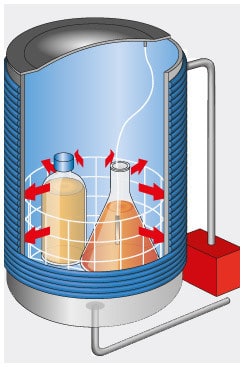
Radial Ventilator
Combined with an optional cooling system which cools the chamber mantle with water while applying support pressure, a radial ventilator can ensure that heat is transported quickly from the sterilized items to the chamber mantle where it is cooled down.
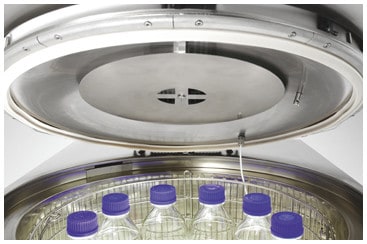
- In order to not reduce the space available within the autoclave, the ventilator is mounted within the chamber door.
- Typical ventilation performance: 71 m3/h
- Reduces time for cooling by 70 % or less
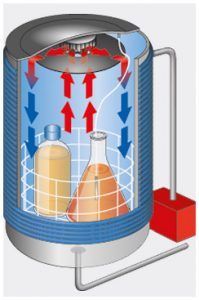
Ultracooler
Combined with optional mantle cooling with cooling water, support pressure as well as a radial ventilator, an Ultracooler heat exchanger can reduce cooling times significantly, thus speeding up the process of sterilization as a whole.
- The Ultracooler is mounted inside the chamber door, surrounding the radial ventilator. This requires no additional space within the chamber.
- Can achieve cooling times of 15 to 60 minutes, depending on the type and number of items which are to be sterilized.
- Reduces time for cooling by up to 90 %
Sterilization of solid objects in Systec VE-Series autoclaves is not recommended, as these do not have a vacuum system. Systec VX-Series autoclaves are more suitable for such applications.
Sterilization of waste in disposal bags in Systec VE-Series autoclaves is not recommended, as these do not have a vacuum system. Systec VX-Series autoclaves are more suitable for such applications.
Exhaust air filtration & condensate inactivation
In order to sterilize hazardous substances, an optional system for filtering air exhaust is available for Systec autoclaves. Its heat-resistant sterile filter is installed in a pressure-proof housing, making it easily accessible. The filter consists of a cartridge with a PTFE membrane – with a pore size of 0.2 μm. The filter is itself sterilized over the course of each sterilization run. The PT-100 temperature sensor also monitors the filter.
During the phase of heating up the chamber and the actual sterilization phase, condensation is automatically retained and sterilized inside the vessel. All existing microorganisms are eliminated effectively, as air exhaust filtration systems and condensate inactivation methods prevent them from escaping during sterilization. This also ensures that hazardous liquids or gases cannot be released but are sterilized and filtered out instead.
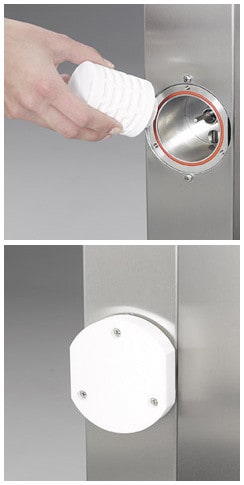
Options
STANDARD: Internal memory

The internal memory for process data uses the internal storage; this is part of the Systec PLC. The capacity is sucient to store process data over an average period of 10 years.
STANDARD: Elektronic data output
The integrated documentation feature is used for comprehensive batch documentation and for exporting the electronic data as PDF or CSV via network interface or USB. The essential values of the individual program phases and process parameters are presented in a tabular overview, followed by a graph and a numerical table of the program sequence.
*the network interface requires the optional „Save to Folder“ feature for downloading the file to an FTP/SFTP server.
STANDARD: Backup feature

The backup function (via USB) enables the user to save and restore:
- program lists and their parameters,
- complete backups of the device with the current device software and its databases.
The backup file is encrypted and thus protected against manipulation.
STANDARD: Real-time clock

The device has a real-time clock with automatic changeover to daylight savings time. Time, date and time zone can be set manually via the touch screen, the web server or automatically via the internet. A time server and an internet connection are required to automatically set the time.
- automatic summer/wintertime
- automatic leap year detection
OPTIONAL: Save to Folder

The „Save to Folder“ function automatically exports the current process log to a server after the cycle has been finished. The following server types are supported: FTP, SFTP, FTPS.
OPTIONAL: SCADA connection

All relevant information (current values of defined analogue and digital inputs and outputs of a device, current process status, alarms) is transmitted by the autoclave using the OPC-UA protocol.
OPTIONAL: Printer

An integrated printer is optionally available for documenting the program type, batch number, date, and time. The printout contains the essential information of a program cycle. It shows the basic parameter settings and the success or failure of a program cycle. The printout is created in the language that has been selected on the device.
OPTIONAL: Advanced CFR Part 11 solution
Data can be downloaded from the autoclave as PDF and/or CSV (Excel) files*, using the USB or network interface**. Both the PDF and CSV files are electronically signed by the autoclave. This electronic signature is clearly assigned to the respective autoclave. It also indicates whether the exported files are valid or not. Any attempt of manipulation will result in the file being marked as invalid.
The advanced CFR 21 Part 11 solution also includes:
- Extended user account control. This includes an individual or global program list for each user, the assignment of the user to an individually created group (e.g. user, supervisor, administrator, cleaner, etc.) which has customizable rights.
- AuditTrail: All executed actions (e.g. changing parameters, starting or stopping sterilization programs) are documented and can be traced back to the respectice user and time stamp (date/time).
- There are up to five fields for electronic signatures. These are used to sign the exported PDF or CSV files on a PC (or any other device with the functionality to sign documents electronically).
* the network interface requires the optional „Save to Folder“ feature for downloading the file to an FTP/SFTP server
** only cycle data can be transferred via the network interface.
Mantle cooling with cooling water and support pressure
A flexible PT-100 temperature sensor is used throughout the entire cooling procedure to monitor the temperature within a vessel that is filled with liquid as a reference measurement. The sterilization period begins only once the temperature required for sterilization has been achieved in the actual liquid instead of inside the chamber.
The temperature of any subsequent cooling processes is monitored as well. Additionally, in order to protect the sterilized items from delayed boiling, the lid of the container can be opened only once the temperature inside of it is equal to or lower than 80 °C, according to industry standards. To prevent the liquid from boiling, support pressure is applied during the cooling-down phase using compressed air which has been filtered to be sterile.
Radial ventilator
Combined with an optional cooling system which cools the chamber mantle with water while applying support pressure, a radial ventilator can ensure that heat is transported quickly from the sterilized items to the chamber mantle where it is cooled down.
Ultracooler
Combined with a water-cooled mantle, support pressure as well as a radial ventilator, an Ultracooler heat exchanger can reduce cooling times significantly, speeding up the process of sterilization as a whole.
Loading baskets and inserts
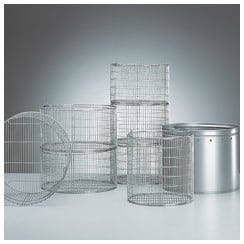
Stainless steel wire mesh baskets, stackable.
Lifting device for heavy items
The electrically operated device with swivel arm facilitates the loading and unloading of heavy items. A mobile control panel with push-button operation makes for ease of use. The device is attached to the side of the autoclave. The swivel arm has a special grip for the baskets that remain stable even under loading conditions.